
Maritime law differs significantly from traditional personal injury law.
It is a specialized area of federal law with unique statutes and legal doctrines. If you were injured on a vessel, barge, tugboat, dredge, or in navigable waters, working with an attorney experienced in maritime law can make an important difference in understanding and protecting your rights.
Attorney Richard J. Serpe has that experience. After law school, Mr. Serpe earned a Master of Laws in Maritime & Admiralty (LL.M.) and has spent nearly four decades representing the injured and their families in claims arising from negligence.
Contact us for a free consultation. You pay no legal fees unless we win.
Richard Serpe, LL.M. in Maritime & Admiralty Law
 Richard Serpe’s maritime law background sets him apart from many Virginia attorneys.
After earning his Juris Doctor, Mr. Serpe pursued his Master of Laws in Maritime & Admiralty at Tulane University School of Law. Tulane’s maritime law program is regarded as one of the best in the world. Only a small number of U.S. law schools offer this degree.
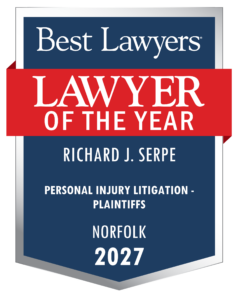
Richard Serpe has been recognized by Best Lawyers since 2005 for his work in personal injury and maritime law. He holds Martindale-Hubbell’s AV Preeminent rating, the highest distinction awarded for legal ability and ethics. He has also been named a Super Lawyer, ranking among the top 5% of attorneys in Virginia, since 2006.
His firm has also been recognized in U.S. News & World Report’s Best Law Firms rankings for excellence in personal injury and maritime law.
Maritime Accidents
The Law Offices of Richard J. Serpe, PC represents individuals injured in a wide range of maritime accidents and offshore incidents caused by negligence throughout Virginia:
- Barge, tugboat, and dredging accidents
- Commercial fishing and offshore accidents
- Crane, cargo, and vessel loading accidents
- Vessel collisions and onboard accidents
- Falls overboard and drowning incidents
- Crush injuries, amputations, and catastrophic trauma
- Traumatic brain injuries and head trauma
- Electrocution, fires, and explosions
- Wrongful death of a loved one
These cases often involve serious, life-changing injuries and may involve employer negligence, unsafe vessels, or other conditions governed by maritime law.
Understanding Maritime Injury Claims
Maritime law provides several types of compensation depending on the nature of the claim, including traditional damages such as lost wages and pain and suffering, as well as unique remedies like maintenance and cure.
Jones Act Negligence Claims
The Jones Act, formally the Merchant Marine Act of 1920, is one of the most important legal protections available to maritime workers. It allows injured seamen to file personal injury lawsuits directly against their employers when negligence contributed to their injury. This is fundamentally different from workers’ compensation claims.
Under the Jones Act, you may be entitled to compensation for:
- Medical expenses (past and future treatment)
- Lost wages and loss of future earning capacity
- Pain and suffering
- Disability or permanent impairment
- Disfigurement and loss of quality of life
To bring a Jones Act claim, you must qualify as a “seaman” under federal law, a determination that requires careful legal analysis. Generally, you must spend a significant portion of your working time in navigable waters and your work must contribute to the vessel’s mission.
Unseaworthiness Claims
Unseaworthiness claims may arise when a vessel, its equipment, or its crew is not reasonably fit for its intended purpose. A seaman who is injured because of an unseaworthy condition may have a claim against the vessel owner.
Maritime Wrongful Death Claims
When a maritime accident results in a fatality, certain family members may bring a claim under federal maritime law or statutes such as the Death on the High Seas Act (DOHSA). Depending on the circumstances, recoverable damages may include:
- Funeral and burial expenses
- Loss of financial support and expected future income
- Loss of services, care, and household contributions
- Loss of companionship (in some cases under general maritime law)
The type of recovery available can vary significantly depending on where the incident occurred (territorial waters vs. offshore) and which law applies.
Virginia Maritime Settlements
Because every case is different, past outcomes do not guarantee a similar outcome, but they reflect do the quality and depth of work we bring to every case.
- $3.5 MILLION: Barge incident on the Elizabeth River causes brain injury
- $2.5 MILLION: Crane barge capsizes resulting in a wrongful death
- $1.25 MILLION: Barge fall injury while working on the James River
- $1.2 MILLION: Barge incident leads to severe injury due to fall
- $375 THOUSAND: Tugboat incident causes injury on the Elizabeth River
Virginia Maritime Client Review
Maritime Injury Cases Across Virginia
Virginia is uniquely positioned in U.S. maritime commerce. Hampton Roads, comprising Norfolk, Portsmouth, Chesapeake, Newport News, Hampton, and Virginia Beach, is one of the largest natural harbors in the world and one of the East Coast’s most active maritime hubs. It is home to:
- Naval Station Norfolk, the world’s largest naval base
- The Port of Virginia, one of the busiest container ports on the East Coast
- Major shipyards, including Huntington Ingalls Industries in Newport News
- A dense commercial tugboat and towing industry
- Active dredging and waterway maintenance operations
- Commercial fishing fleets operating on the Chesapeake Bay and Atlantic Ocean
The Law Offices of Richard J. Serpe, PC represents maritime workers and their families throughout Virginia, from Hampton Roads to the Chesapeake Bay, from the Eastern Shore to the inland rivers and waterways where commercial activity takes place. Distance is not a barrier to representation.
Contact Our Virginia Maritime Lawyers
We are here to help. Your consultation is free. You pay no legal fees unless we win.
Call or text (757) 233-0009, use our chat, or send us an email today.